Touch-driven Curtain of Skin


Yesterday, in The Atlantic — an article of increasingly troubling scenarios,
concluding: only Putin can step back and stop a major war.

An hour later I’m listening to Ideas on CBC —
the idea being discussed: the neuroscience of touch,

and the interviewee says, If there was more touch in this world
there’d be less violence, less war.

And being a simple man of cause-and-effect I was lead
to ponder the personal life of Mr. Putin, how perhaps,

his skin has not been frequently moved by the hands
of an intimate, and concomitant to his thirsting soul,

his aggression is rising toward that final embattled scenario, whereas,
everything on earth — shuddering cinder, swirling gales of ash.

Of course it’s here where I like to believe the simplicity
of my early morning Psalter, refuting the article’s author,

by noting that God is the author of outcomes,
but on this, history appears equivocal.

Then I think, as I’m a simple man, that whatever happens,
however many seconds there’s left on that damnable clock in Chicago,

we owe it to the mystery of our breathing, the penumbra
of our own spinning star, the gardens on the margins of galaxies,

to keep repairing the human breaches with handshakes and hugs,
with greetings, with smiles, with songs — all forms of touch —

songs that frisson emotion and leaven empathy, soul and body,
our human hymn book of common brokenness.

It was Ricoeur who said everything is profoundly cracked,
but it’s Cohen we remember, he put it into music,

kept us from straying, kept us reaching toward the flickering,
emanating from these honeycomb curtains of skin.

So while the moon feels its way through your hair
and a kitten rubs its face on yours to keep you awake

and playful, and in the morning your partner
rolls over to hold you, says, Come, let’s fetch the lilacs,

and hand in hand, as you make no noise walking
on the pine-shaded path under the eternal sun —

give thanks,
for these porous, touch-craving containers of light.


Master Plan: Shackle You To Me With Happiness

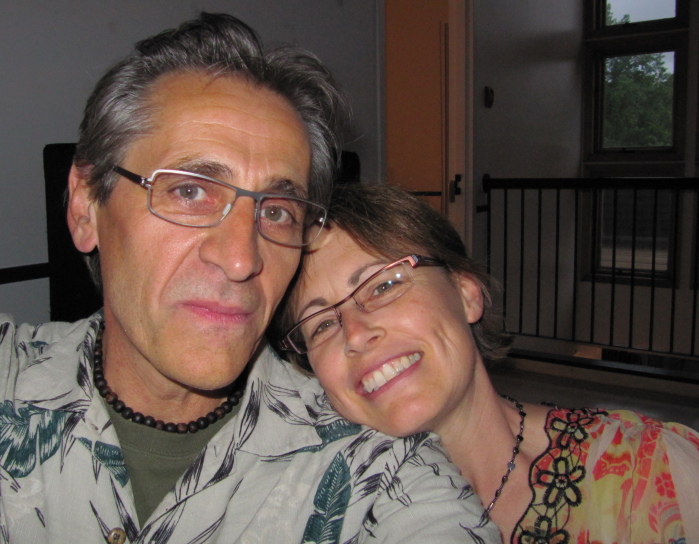
To my life partner: Happy 60th Birthday! (We’re a bit younger here.)


I’m going to rig the news feed on your laptop,
make it bring you only the best headlines: Whidbey Island’s
Lone Trumpeter Swan Gets a Partner.

I’ll train a parrot to always locate and retrieve your phone,
which, because of the Silicon Valley native I’ll hire,
can only be used to take pictures of waterfalls, and receive
amusing, interesting, or joyful texts.

I will piggy-back you all the way to the top of Mount Robson
so you can look down on all the hidden lakes, perfectly turquoise;
on the way down we’ll stop at Berg Lake for a lunch I’ve prepared, with
extravagant devotion, and toast our reflection under a warming afternoon sun.

I’m going to hire a contractor to divert Tzuhalem Creek past the patio
off our bedroom, and every night you’ll fall asleep, and every morning
you’ll awaken to the orchestral hush of running water.

Such contented bees, I’ll find (untroubled, as to match your treehouse days),
and every June and September we’ll harvest pounds of honey
made from the flowers of our own lavishly blossoming blueberries.

My master plan will include insuring your own pink health
with which to enjoy the permanently restored well-being
and ongoing flourishing of every one of our kids — and that’s how,

while thinking of blossoms, I hit upon my ingenious strategy
to take you to the ancient city of Kyoto, where at 60,
they give you a choice to start counting backwards,
or if you prefer, start over again —

but on this, a proviso: I get to be young too, again, with you,
watch you drive up the lane, windows down,
that red polka-dot dress, your face, that smile,
as I rush out the front door, pretending a calm coolness.


At the Gravesite


“I’d rather be cremated,” he said.

We stood in a prairie graveyard, a late fall wind blew through
a faded red snow fence and a row of poplar trees,
their leaves already shaken free.

“I was taught cremation was unnatural,” I said. “In the church
I grew up in, it might have been illegal, now it seems sensible.”
“True,” he said, “and besides, how else to be buried
in different places at once — every lapping seacoast, if I had my say.”

“Me? near the old farm, that bend by the bridge on the Whitesand River,
and that wide open bay on Hornby Island, and the abandoned
forestry lookout my son and I hiked to, above Rocky Lake.”

“Of course it requires the good will of others, family can be lazy,
you could get thrown out of someone’s car window.”

“Anywhere along the Yellowhead is fine.” I said.
“What about people needing a place to visit?”
“All the better to have your ashes scattered over the country —
no one has to drive far.”

The pastor was gripping the lapels of his coat with one hand
and held a bible with the other, many words went up into the wind.

“I like the thought of my ashes caught in the grass,” I said,
“caught in the rain, absorbed by soil, my atoms ending up
in different forms, yet held, alive and seeing, in the Divine,
the all of me in a molecule, blinking out from the bloom
of an orange hawkweed,
growing in the ditch by our old cabin north of Edmonton.”

They were lowering my cousin into the earth with one of those
chrome-frame scaffold cranes. We watched as an older brother
threw a handful of dirt on the coffin.

“It looks like oblivion,” he said. “There’s nothing here
to convince me that consciousness survives.
It may be healthier to accept what’s apparent than to dream
of some kind of afterlife, whether on silver streets in golden clouds,
or in that orange flower of yours.”

“Oblivion is one truth. That there is a persistent mystery
begging attention at the heart of our existence is another.”

“The truth? We die.”
          “But we resist.”
“That’s evolution.”
          “That’s something built into the soul.”
“That’s animal survival.”

People were gathered around the bright-green fake-lawn carpet
that covered the mounds of dirt. They were singing,
Leaning on the Everlasting Arms,
and the wind under a slate sky was blowing hard.

“I’ll give you this,” he said, “there’s lots we don’t yet know about ashes,
lots we don’t know about the infinite number of ever-changing
information-bearing patterns.”
“Perhaps all part of one grand pattern?”
“I see where you’re going, but God is a problem.”

The pastor asked for a moment of silence. Under the grey light,
wet faces, shielded with scarves and raised collars, turned toward the casket.

“Any genuine experience of love is God.”
“Or,” he said, “any genuine experience of love is a physical phenomenon
exhibiting the fertile force of that fourteen-billion-year-old accident,
and that my grateful acknowledgment is on par with your worship of God.”

“You have a strong point — it leaves me, necessarily, to fall back on mystery.”

“There are imperious nihilists here, as you have adolescent crusaders there,
mirrors of each other, but the problem with many of you believers,
is that you think we nonbelievers lead shrunken lives,
sealed off from transcendent experience; but beauty, for instance,
enlarges life for me, as much as for you. My capacity for joy,
and grief, is not diminished because I believe in a material world.
You say God, I say physics, albeit, wondrous.”

“I think I say God before physics.
But I suppose we part ways here: for me, joy, sorrow, beauty, awe, all point
beyond a material world; awe, without an end, seems like dread,
potentially ending in despair. Although, that said,
dread, oblivion, the void, may also be a means to deeper seeing.

Some people were moving back to their cars, deliberate, slow bodies
lost in memories, lost in bewilderment, belief, unbelief, grace, pain.

“Suppose,” I said, “we were glimmerings in the mind of God (what love!)
even before that supermassive bang? Then, the quantum news
that we are one with everything around us, gives way
to a newer-older news, that you, me, all things, are at every moment,
in a relationship with that Mother force — God,
before we are in relationship with anything, with anyone.
How then should I approach the world and every living being,
if not with great reverence?

“Well, in this,” he said, “we are kin my friend, we live towards
the affections we hold, using different forms of navigation,
until some new information (revelation?) changes, modifies,
solidifies (maybe reverses?) this drift to disorder.”

We stood, our backs to the gusts, in a sort of silent covenant,
brothers, in a kind of searching wonder,
a wonder that only wind has the words to utter.

Car doors were open, but people were still in clusters,
holding one another, elbows held in palms,
hands folded in hands, arms linked, some embraced
as to shatter, as to deepen, the ice of grief,
some simply hugged,
if a hug can ever be called simple.


The Healing Game


The Walmart dracaena is losing its leaves, the soil is too wet, compacted,
she will find a more generous pot, set its roots free,
help it stand again.

If it was spring and if there was space behind this townhouse,
she’d be putting plants in the ground.

When she drove out to Alberta in the fall
she made a point of taking her sowing machine and scraps of material.
While she waits, she builds a quilt.

There is a drive in her to mend things, change things,
hem the curtains, make this basement bedroom look roomier, create
the illusion of space for a living room.

She has attacked the aging carpets with steam,
the floors and fixtures and worry with vinegar.

Today she is painting walls a brighter shade of yellow,
sometimes it takes three coats for her to be satisfied.

Soon there will be paintings, framed photographs, she will find them,
she knows where to look, knows how to blend colours, how to
soften walls with images.

Goodwill is her zendo, her place for gathering ideas and furniture and fittings.

In the laundry room, off the bedroom, she has created a kitchen.

In the evening, beside the closet that doubles as sewing room, she reads,
rests, on her steam-cleaned Goodwill chaise lounge in our living room.

Morning, through the glass patio doors still frozen to their metal sliders, 
she watches a blush of red under the taut gray-flag sky, and remembers
a Van Morrison song, called, Fire In the Belly:

gotta get through January, gotta get through February,
gotta get through January, gotta get through February.

On that same album there is a song called, Healing Game:
Sing it out loud, sing it in your name, sing the healing game,

sing the healing game,
sing the healing game.

There is a fire in her to see something grow, a hunger
to see something stand again, green and tall, full of sap and flowering,

while she caretakes, while she waits,
endless months for her son to rise, to stand,
to see a sunrise.