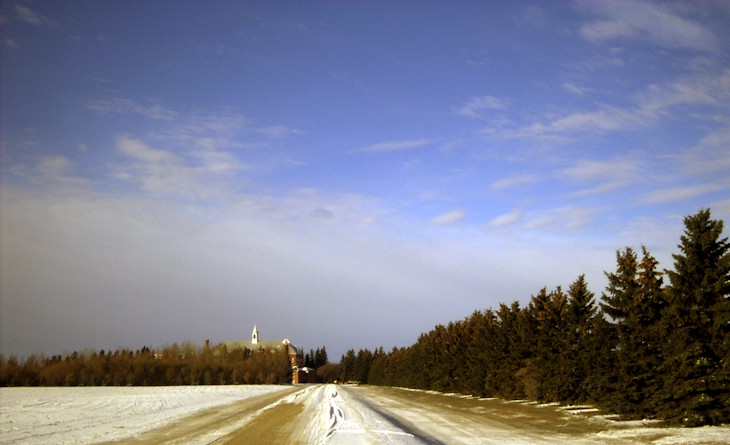
Apology to a Childhood Friend


We bummed cigarettes from each other. Blew
smoke rings across the Yorkton Regional loading dock.
Had nicknames for each other.
I was Jake, you were Schnitz.
We rode the same Yellowbird school bus. Our farms,
either side of the Yellowhead Highway, were mere miles apart.
I was skinny, you were short, but built like a Cockshutt tractor,
with the quickness of a Dodge Charger.
In the church basement, you drew up a chair beside me.
What should have been familiar—your sturdy bearing, blue eyes,
ready-to-laugh sideways smile, hair, still swept to one side,
thinning, greying, but signaling blond—at that moment, escaped me.
Forgive me.
I think you actually had to say your name.
Something about not being recognized feels like a shrug.
I knew the moment you felt it. You covered it, laughed, come on!
We carried on as adults, reminiscing.
There are expectations we carry with us. One is: how it will be
when an old friend, 40 years in, sees you again.
And what could I have said to remove the sting?
Funny how some things, seemingly minor, don’t allow undoing. And
the more personally rooted, the more impervious they are to words.
I couldn’t bridge it. And all our foolish-laden, yet gilded history
receded like dust in a prairie wind. Friend,
I want you to know I occasionally revisit that afternoon at the funeral.
It goes like this: I’m in the church basement waiting for you,
as I’d picked you out while I was giving my eulogy.
And when I see you carrying a chair over to my table,
I spring up and go to you, and we embrace in that guy way,
slap shoulders, and I say, Can I bum a smoke?
and you laugh that raucous high-school-laugh of yours.
 

Ode to the Psalms


For twenty-five years (according to my journal), I have started my day by reading Psalms. Every month, loosely obedient to St. Benedict, I make my way through the 150-song psalter.

I read the old King James version (mainly) and try to read in the monastic way, not unlike the way my uncle Harold did at the breakfast table: slowly, reverently, audibly.

It’s a good way to start the day. It’s a crap way.
I love the Psalms. I hate the Psalms.

I hate them for exposing my motives, my secrets, my resentments.
I love them, for they fathom my darkness, my fear, my desire for security.
I condemn them for their paternalism; I delight in them for their humanism.
I spurn them for their violence and vengeance in the name of God;
I understand them for the same.

Whatever you throw at them will stick. Fire any kind of emotional missile at them, it’s absorbed. Tell them your hateful, vengeful thoughts, every cruel wish, they’ve heard it all before, and worse.

Wonder at their beauty, their quintessence of phrase, their turns of tone,
ride their crescendos of hallelujahs over the hills of praise, then,
plunge into some fiery abyss, choking on their burning words.

You want a ruthless God, a hungry-lion God, a John Wick, Mad Max God? He’s here in all his jealous, furious, warriorlike might, slaying your captors, your enemies, while the dogs lick blood from your shoes.

You want a tender, merciful, consoling God? She is here, holding you, reminding you of your worth: her full attention on your naked, breathing body, her loving thoughts of you, more than all the grains of sand.

You want a heartbroken God? Lead a thankless life.
You want a happy God? Be kind, feed the poor.
You want a joyful God? Open your ears to the cries of the world.

You want an ear for your anger? a hiding place in a harsh night? a blunt reminder of the brevity of life? a target for your curses? a room for grieving? green grass for beauty? still waters for serenity? want to fling taunts, hurl barbs of doubt in God’s face? want to return, hat in hand, and be welcomed as though you’re God’s own child? Done!

These are purgative prayers that cut an X in your thigh,
suck out the venom surging toward your brain.
These are praiseful poems that arrest the self-idolizing ego, then
call out: come, with your torn and battered and wildly contradictory faith.

Read these poets through the lens of politics and shudder at their insight.
Read these poets through the lens of culture and wonder at their modernity.
Read these poems through the lens of earth-care and grieve the groaning of our planet.
Read these poems through the eyes of Christ and enter his wounds, his suffering love.

In every abyss, every cry, every agonized why? in every shout of joy, in all of it, the Psalms simply say, God is.

Take them as you will, they care little for your arguments, your intellect, your ontology; they only report an entanglement with an I Am within and beyond creation. An entanglement that speaks to your heart, your oh-so-human heart.


Obedience to the Unenforceable


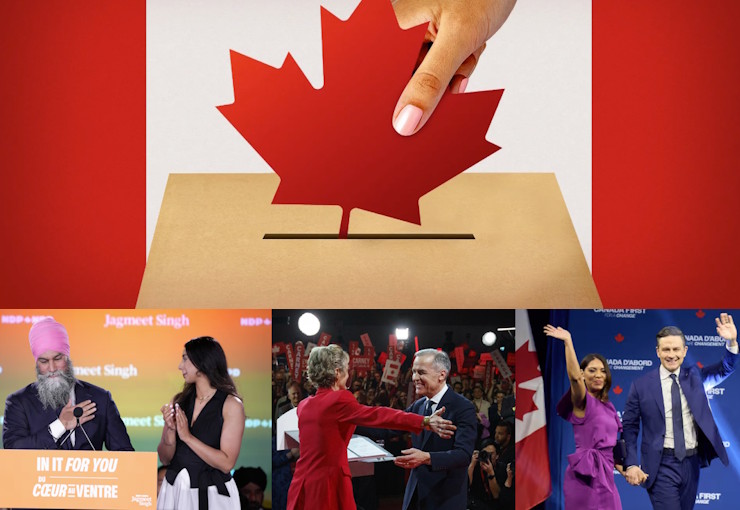
The lesson of Monday’s Canadian election, for every leader and every party, was and is humility.

For Pierre Poilievre, mere months ago, comfortably gliding to become our Prime Minister, proud of his attack-dog status, his flair for stirring his base and chaffing his detractors, unbowed by Parliamentary censor for his “wacko” rebellions, too often reminded me of a man mired in ego who finds pleasure in spectacle. Personally, I don’t know if this is fair. This, however, appeared to be his public/political persona.

And it reminded many of the “leader” to the south. While Poilievre clearly isn’t Trump, he mimed the condescending stylings of Trump, his addresses cloudy with slogans and nicknames. Fox News carried and applauded his “apple-eating interview” (CBC called, the “orchard overture”), which was recorded and promoted by the Conservatives (T-shirts still available). Now, having lost his own seat, he’s stewing in the consequences of that compote. (This may have been the election Erin O’Toole would have won.)

I’ve found this to be true: that there are no paths to humility except humiliations recollected in seclusion, pondered in self-honest serenity. Mr. Poilievre has an opportunity here.

While humility does not yet appear to be in Poilievre’s vocabulary (I scanned the transcript of his concession speech), Mark Carney mentioned humility six times.

“I am going to begin with the value of humility and by admitting that I have much to be humble about. Over my long career, I have made many mistakes, and I will make more. But I commit to admitting them openly to correcting them quickly and always learning from them.”

And this:

“There is also, for me, …humility in recognizing that [while] many have chosen to place trust in me and the Liberal Party, millions of our fellow citizens preferred a different outcome.”

It would seem Prime Minister Carney has noted that the popular vote between Liberals and Conservatives was virtually a tie. Sadly, in my view, his victory came at the expense of the NDP (as well as the Bloc Québécois).

And the NDP, whose platform I support, who I voted for, has now lost official party status. And Jagmeet Singh has resigned. Enough humility to go around for all of us. (Not to mention the Green Party.)

Nevertheless, it was heartening to hear what these three leaders said in their post-election speeches, that, unity must eclipse partisanship. Perhaps this is Trump’s unwitting gift to Canada.

Those who wish to stand out through veiled or unveiled arrogance are all the same. It’s humility that differentiates, that stands as a light on a hill. And it’s humility that saves us from our failures and allows us to rise again, together.

There’s a kind of exhibitionist vanity that attracts and fascinates the collective eyes of our culture; humility, however, adds beauty to community and to our creation, because it draws attention away from ego to the transcendent Mystery of interconnection.

To riff on a quote by Emmanuel, Cardinal Suhard, humility is the ability to live in such a way that one’s life would not make sense if love, kindness, compassion, did not exist.

My friend, and unassuming mentor, Mary, calls this obedience to the unenforceable.

Sister Joan Chittister OSB, said,

“Humility, the lost virtue, is crying to heaven for rediscovery. The development of nations, the preservation of the globe, the achievement of human community depends on it.”


May those who Sow in Tears, Reap with Shouts of Joy


May those who sow in tears,
reap with shouts of joy. Psalm 126

threatening shadows
a stab of deep pain
the clock’s constant warning
endings mounting like thunderheads
the hard rain,
a compression of tears

then, the perfumed damp of dawn
a bridge breathing an outline
the half-wheel of sun
a hum without menace
the day unhurried, the day entire
the shouts,
a mosaic of music