Sunday Evening Revival Meeting and a Short Train

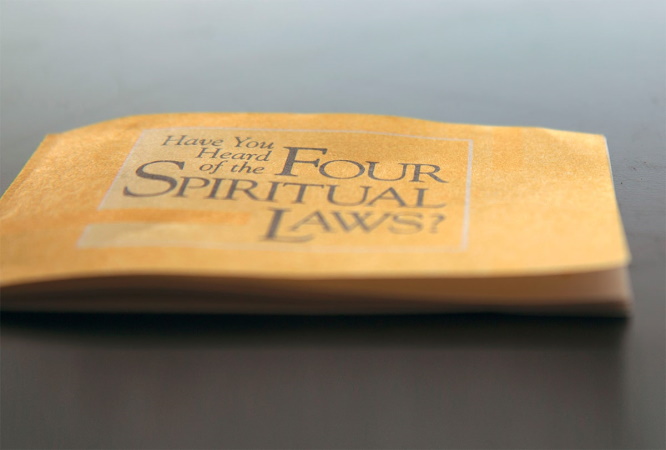
Grow up evangelical and you’ll not avoid the revival meeting. (You’ll also be familiar with this booklet). Still, however you view it, Holy Spirit or hypnosis, or somewhere in between, there is a kind of electricity that builds and spreads, not unlike a fueled Grateful Dead concert. But I don’t disparage. For some, perhaps many, it’s life-altering. This was not quite that.

Sunday Evening Revival Meeting and a Short Train

Bodies were swaying as in a gale of grace. It looked like a storm of intimacy: shining faces like flares of mercy, arms embracing under a hail of forgiveness. And you, from your drifting raft, raised your hand, moved down the aisle and knelt at the altar.

An usher handed you a booklet of spiritual laws — precisely four. Jesus was there, and the Holy Spirit, plus the Father, all three of them drawing diagrams with arrows and crosses, drafting a plan for your life.

God the Father assumed the pen and drew a really short train: just two cars, plus an engine he called, Fact. He drew you as a stick man sitting on the engine and wrote in a bubble: You Have Entered Into A Personal Relationship With Christ.

The storm had passed, and you were hoping to talk to one of the counsellors, maybe a spiritual mentor, or even the usher; but his head was on some kind of swivel and he was talking over you, and his finger was stabbing at the car labeled, Faith, telling you to get in.

But you were in the caboose named, Feeling. Tending an old wound, longing for an exit, and yearning for something you couldn’t define. Still, this small dawning: how you had raised your hand, knelt at the podium, not for heaven, really, not even for Christ, who you’d just met, but for some genuine human connection.
Gentle Observation


The morning glory —
another thing
that will never be my friend  – Basho

The heavens declare the glory of God,
the firmament shows God’s handiwork.  – Psalm 19


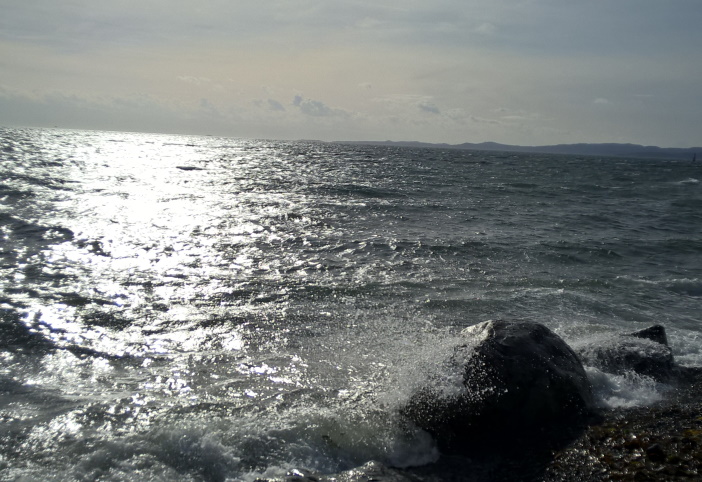
The rock sitting in the heaving surf is the size of a V-8 engine. Incessantly, the sea throws cylinders of water at it, and the rock retaliates with explosions of white foam.

But perhaps I’m mistaken about this relationship. At times the sea is a wild-haired, many-breasted goddess; and the rock is a minor prophet, surrounded by parchment, opening ancient scrolls, holding them up one after another.

I come here often. I sense something spiritual. Yet the sea has no need of my friendship. It rises, full of mystery, and recedes, offering a brief slip of perception. The rock stands alone, watching. It has never asked me for directions. It has no need for my greedy observations, which every day, turn up wrong.

But one day I came to the rock, blind. That is, my eyes were on the sea-leaning cedar farther up the beach that carried twenty resting gulls. I was deep within their feathers and the tireless tree when I felt the slow energy of the rock, a kind of hum, perhaps the plainsong of life’s entangled currents — and between me and the rock and the sea, there was no break.

It was good to be given this true thing. And as with all true things, it held no command that one should carry it home and make a religion. Instead, I felt assured it would find me, again, when I was ready.


A Pile of Leaves


Now here is a common story that happens in early October, on a clear, gorgeous Saturday, when whole neighbourhoods are out in their yards, stowing patio furniture, gardening tools, mowers, raking leaves into piles,

everyone, seemingly, pitching in, except for an adolescent son, lying on the deck, dreaming, occasionally teasing the cat with string and a small rubber ball, lost in a far place, a cat universe, who knows…

and a father who shouts to the son, Move! and the son who makes a pretense of rising, of lifting himself away from his play, but never quite getting to his feet, never getting to his chore,

never quite listening to the father who is bent to get fall clean-up done before the weather changes, before the snow comes, already, frost in the air,

the poplars and birch, once beautiful in their yellows and golds and touches of crimson, now standing naked, corpse-like, and ready for winter — and again the father yells at the son, Move! I said Move!

Do you recognize this story? the way the son looks at the father in affected confusion, as though the father is speaking Latin, the son again looking away, as though some breezy, heedless force is calling for aimless musing of such requests — and the father, shouting, echoing, as though to penetrate that force.

Memory is a pile of leaves, you can bury anything there, pain, shame — an image of a father, enraged, breaking a branch over the trunk of a tree, in the manner of a threat, an instant failure, a dismal spectacle,

and the image of a son, who lowers his eyes and picks up the rake, a final image of a father who turns to hide his face, a pulpy thing, a fading flush of blood — I’m sorry! — drop them in, cover them over with leaves,

until decades later, the grey-headed father, culling papers in his office, and a picture drops from the pile, of a teenage boy, running, laughing, launching himself into a pile of leaves, and a father, watching from the back deck — something like joy,

happy, just the way some stories can end, with the image of a father, sitting in a pile of papers and memories, his creased and stubbled face, smiling, his lined eyes, wet, and long forgiven.

Psalm 120


We are for peace, cry the mothers in Russia,
Cry the children in Ukraine,
Cry the women in Tehran,
Cries the prone journalist in the West Bank.

But when we cry, you are for war,
As though war has honour and glory,
As though war is redemptive and winnable,
As though war has meaning beyond title and profit.

Woe is me, that I live on the streets of Kyiv,
Woe is me that I starve in the dark in Moscow,
Woe is me that I march with the doomed in Iraq,
Woe is me that I’m killed taking pictures in Palestine.

In my distress, I cried unto the Lord,
But the Lord is busy weeping over our rush to extinction, or
The Lord has taken some time away, weary of being claimed, then praised, or
The Lord has a dark side, unimaginable, like the inside of a volcano.

I screamed, Deliver my soul, O Lord,
From treacherous lips,
From tongues of terror,
From exploding arrows.

We are on the run, O Lord,
From men that hate peace,
From shareholders that hold hostage the world,
From presidents that wrap themselves in priestly linens
And pray to the Lord.

We are on the run,
We race, breathless across open fields,
We hold each other’s hands, carry our babies, and run,
We tell our little ones
We are between homes.